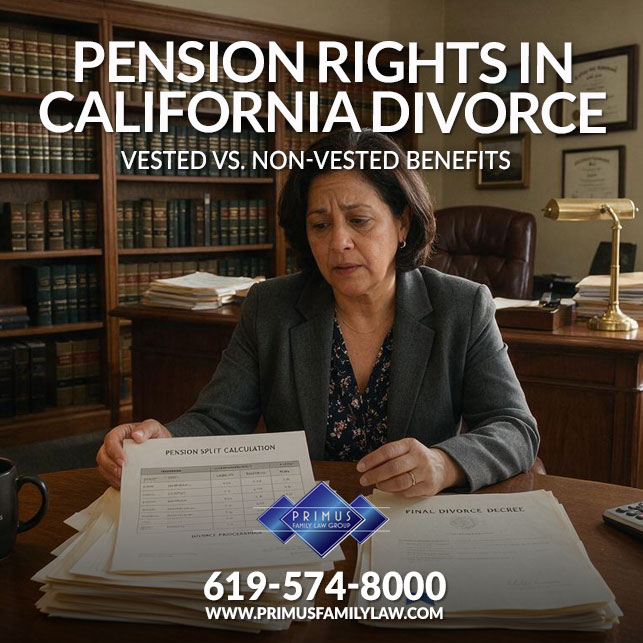
Q: Are pension benefits considered marital property in a California divorce?
A: In California, the portion of a pension earned during the marriage is generally considered community property and is subject to division in divorce. This means that even if only one spouse was employed and contributing to a pension plan, the other spouse may have a legitimate claim to a share of those benefits. The portion earned before the marriage or after the date of separation typically remains separate property. At Primus Family Law Group, our California Certified Family Law Specialists work to ensure that retirement assets are properly identified and characterized so our San Diego County clients receive what they are rightfully owed.
Q: What is the difference between a vested and a non-vested pension in divorce?
A: A pension is considered vested when the employee has worked long enough to earn a guaranteed right to receive benefits at retirement, regardless of whether they remain with the employer. A non-vested pension means the employee has not yet satisfied the required length of service to guarantee those benefits. In a California divorce, both vested and non-vested pension benefits earned during the marriage may be treated as community property. The fact that a pension has not yet vested does not necessarily remove it from consideration in the property division process. Senior Litigation Specialist Kimberly A. Soule, a California Certified Family Law Specialist, often handles these nuanced asset questions for clients throughout San Diego County.
Q: How are non-vested pensions handled if the employee spouse never fully vests?
A: California courts have addressed this situation through what is known as the time rule, which calculates the community property share of a pension based on the ratio of time worked during the marriage to the total time worked to earn the benefit. If the pension ultimately never vests, there may be nothing to divide. However, courts can issue orders that protect the non-employee spouse’s interest on the condition that vesting eventually occurs. Wayne J. Rice, our California Certified Family Law Specialist Of Counsel, brings considerable experience navigating these contingent asset issues in complex divorce matters across San Diego County.
Q: How does a court actually divide pension benefits in a California divorce?
A: Dividing a pension requires a specialized court order called a Qualified Domestic Relations Order, or QDRO, which instructs the pension plan administrator how to distribute benefits between the spouses. Whether the pension is vested or non-vested at the time of divorce, a properly drafted QDRO can protect the non-employee spouse’s share and ensure it is paid when benefits become available. At Primus Family Law Group, located in Mission Valley and serving all of San Diego County, our California Certified Family Law Specialists with over 50 years of combined experience work diligently to protect our clients’ financial futures through zealous advocacy for what is right and reasonable.
To schedule a free 30 minute zoom or telephone consultation with a California Certified Family Law Specialist at Primus Family Law Group, contact our Mission Valley office today at 619.574.8000 or visit our website at www.primusfamilylaw.com.